
Introduction
In February 2026, Prime Minister and Minister for Finance Lawrence Wong delivered Singapore’s Budget 2026 Statement – and tucked within the headline announcements was a policy change that sent shockwaves through the local automotive industry. The Preferential Additional Registration Fee (PARF) rebate, a long-standing financial cushion for car owners who choose to deregister their vehicles before the end of their 10-year Certificate of Entitlement (COE) cycle, was slashed by 45 percentage points across all age tiers. The rebate cap was also halved from S$60,000 to S$30,000.
The move was described by the government as a natural adjustment in line with the growing adoption of electric vehicles (EVs), which are inherently less pollutive and therefore reduce the urgency to incentivize early deregistration. But for everyday Singaporeans who have long factored PARF rebates into their car ownership calculations, and for businesses across the automotive ecosystem, the implications are profound.
In this article, we break down exactly what changed, examine whether car ownership in Singapore remains financially viable, and explore how the new PARF landscape reshapes the economics of the car rental industry – and the opportunities it creates for companies like Asia Car Rental.
Key Takeaways
- PARF rebates cut by 45 percentage points across all tiers. Cars deregistered within five years now receive just 30% of their ARF (down from 75%), and those scrapped between nine and ten years receive only 5% (down from 50%).
- The PARF rebate cap has been halved from S$60,000 to S$30,000, affecting luxury and high-ARF vehicles most severely.
- Changes apply to vehicles registered from 13 February 2026 using COEs obtained from the second COE bidding exercise of February 2026 onwards. Existing vehicles are unaffected.
- Electric vehicles are largely shielded from the impact, as their PARF values were already low after EV Early Adoption Incentive (EEAI) and VES rebates. The policy nudges buyers toward EVs.
- Car ownership in Singapore just got more expensive, but it is not yet unviable – it requires a shift in how Singaporeans think about the total cost of ownership.
- Car rental companies stand to benefit significantly as higher depreciation costs drive more Singaporeans away from ownership and toward flexible rental or leasing alternatives.
- Rental fleets may be restructured as operators reassess the economics of fleet acquisition, vehicle lifecycles, and residual value planning under the new PARF rules.
Understanding PARF: A Quick Refresher
Before diving into the implications, it helps to understand what PARF is and why it has historically mattered so much to Singapore car owners.
When a car is registered in Singapore, owners pay the Additional Registration Fee (ARF) – a tax calculated as a percentage of the vehicle’s Open Market Value (OMV). The PARF rebate was designed to reward car owners who chose to deregister their vehicles before the expiry of their 10-year COE, essentially refunding a portion of the ARF they initially paid. The sooner you scrapped the car, the bigger the rebate.
This mechanism served two purposes. First, it encouraged the timely renewal of the vehicle population, keeping Singapore’s roads safer and cleaner. Second, it gave car owners a meaningful financial return at the end of their ownership cycle, which could be channeled into purchasing their next vehicle.
For many Singaporeans, the PARF rebate formed a critical pillar of their car budgeting strategy. Knowing that deregistering at, say, the seven-year mark would return a substantial sum made the ongoing cost of ownership feel more manageable.
What Changed in Budget 2026
The revised PARF rebate schedule reduces the percentage returned across every deregistration age tier by a flat 45 percentage points. Here is how the tiers compare:
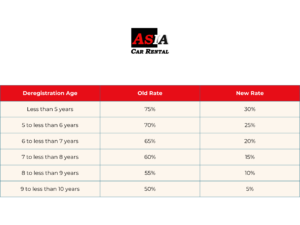
Additionally, the maximum PARF rebate cap has been reduced from S$60,000 to S$30,000. For context, take a petrol car with an ARF of S$25,000. Under the old scheme, deregistering at year four would yield S$18,750. Under the new scheme, the same owner walks away with just S$7,500 – a difference of S$11,250.
The revised rules apply to cars and taxis registered with COEs obtained from the second COE bidding exercise of February 2026 onwards, or for COE-exempt vehicles, those registered on or after 13 February 2026.
Is the Car Ownership Dream Still Feasible in Singapore?
This is the question on every motorist’s lips. With COE premiums already eye-watering, ARF taxes steep, and now PARF rebates gutted, is owning a car in Singapore still a rational financial decision?
The honest answer: it depends on who you are, what you drive, and how you think about value.
The Numbers Have Changed – But Not Insurmountably
The PARF reduction does not change the upfront cost of buying a car. What it changes is the residual value calculation at the end of the ownership cycle. In practical terms, annual depreciation on newly registered cars will rise because owners can no longer count on recovering as large a portion of their ARF when they deregister.
For mass-market buyers – think entry-level sedans and compact SUVs – the ARF values are relatively modest, so the absolute dollar reduction in PARF rebates is smaller. The financial blow, while real, is less severe than the headlines might suggest.
For luxury car buyers, the situation is starkly different. A high-ARF vehicle previously capable of attracting close to S$60,000 in PARF rebates now maxes out at S$30,000. That is a massive absolute reduction, and it dramatically increases the true total cost of owning a premium vehicle in Singapore.
The 10-Year Strategy Is Back in Fashion
One of the unintended consequences of the new PARF schedule is that it makes keeping a car for its full 10-year COE more rational than before. When early deregistration no longer yields a meaningful financial reward, the incentive to swap cars mid-cycle weakens. Owners who keep their cars until year 10 are not giving up much under either the old or new scheme at that stage, since the old final-year rebate was 50% and the new one is 5% – both of which are eclipsed by the other costs of renewal.
This shift in owner psychology will likely reduce the frequency or vehicle turnovers. Fewer cars being deregistered early means fewer used cars entering the market mid-cycle, which could tighten used car supply and support used car prices – at least for vehicles registered under the pre-February 2026 rules, which retain their higher PARF values.
Electric Vehicles Emerge as the Clear Winner
The budget revision is unambiguously designed to tilt the playing field further toward EVs. Because EV buyers already benefit from the EV Early Adoption Incentive and the Vehicular Emissions Scheme rebates, their ARF values are significantly reduced upfront. This means their PARF rebates, even under the new lower percentages, start from a lower base – so the absolute reduction in rebate is smaller.
With Singapore targeting 100% cleaner-energy vehicles by 2040 and EVs already accounting for approximately 45% of new car sales in 2025, the government is sending a clear market signal: if you are planning to buy a new car, EVs offer the most financially stable ownership profile going forward.
So, Should You Still Buy a Car?
For many Singaporeans, the car remains more than a financial instrument – it is a quality-of-life choice. Families with children, professionals with demanding schedules, and those who live in areas underserved by public transport will continue to value personal vehicle ownership for its convenience.
However, the financial calculus has shifted. Prospective buyers must now build higher annual depreciation assumptions into their budgets, factor in the reduced end-of-cycle rebate, and weigh this against the growing ecosystem of alternatives – including long-term car leasing and rental options that increasingly offer comparable flexibility without the capital commitment of ownership.
How the PARF Changes Affect Singapore’s Car Rental Industry
While individual car owners are grappling with the personal implications of the PARF changes, car rental and leasing companies face a set of structural shifts that will reshape how they plan, price, and position their services.
Higher Depreciation Costs on New Fleet Vehicles
Any car rental company that acquires new vehicles registered after 13 February 2026 must not contend with higher effective depreciation costs over the life of those vehicles. The reduced PARF rebate at end-of-fleet cycle means the residual value of each vehicle, when it is eventually deregistered or sold, will be lower than previously anticipated.
This has immediate implications for fleet planning. Companies that previously modelled five to seven year deregistration cycles to capture healthy PARF rebates will need to revisit their assumptions. In some cases, holding vehicles for the full 10-year COE cycle may become more financially prudent – even if it means carrying older vehicles that incur higher maintenance costs.
Fleet operators will need to work more closely with financial institutions and vehicle valuers to recalibrate residual value projections under the new PARF structure. This is not a crisis for well-managed operators, but it demands a sharper pencil in financial modelling.
Rising Demand for Rental as Ownership Becomes Costlier
Here lies the most significant opportunity for car rental companies. As the true cost of car ownership rises – driven by higher depreciation under the new PARF regime – more Singaporeans will reconsider whether ownership is worth it. For those who drive infrequently, or who value flexibility over asset ownership, long-term car rental increasingly makes financial sense.
This is not a new trend, but Budget 2026 has accelerated it. When the financial buffer of a meaningful PARF rebate disappears, the perceived advantage of ownership diminishes. Rental, by contrast, offers a fixed monthly cost with no residual value risk, no large upfront capital commitment, and no exposure to fluctuating COE prices. For budget-conscious Singaporeans, this value proposition becomes more compelling with every policy change that raises the cost of ownership.
Car rental companies that position themselves as smart, accessible alternatives to ownership – rather than just a stopgap solution – stand to capture a growing segment of the market.
The Used Car Wildcard
One side effect of the new PARF rules deserves particular attention: the used car market for pre-February 2026 vehicles may heat up significantly. Since older cars retain their higher PARF rebates under the grandfathered rules, buyers who want to minimize their depreciation exposure may opt for used vehicles over new ones.
For rental companies, this creates a window of opportunity. A well-maintained used vehicle registered before the PARF changes carries a higher residual value at deregistration than an equivalent new vehicle registered under the new rules. Companies that already have such vehicles in their fleets are sitting on a relative advantage – their fleet economics are better than those of competitors who renew their fleets with newly registered vehicles
Pricing and Competitive Dynamics
As fleet acquisition becomes more expensive on a net depreciation basis, some rental companies may face pressure to raise rental rates to maintain margins. This is a delicate balance in a competitive market, but it is an industry-wide challenge rather than a company-specific one.
The players best positioned to weather this shift are those with diversified fleet profiles, prudent financial management, and established customer relationships. Companies that over-leveraged themselves on aggressive fleet expansion – as seen in the Autobahn-Shariot episode – will find the new environment even more unforgiving.
Opportunities for Car Rental Companies Under the New System
Every policy shift creates winners and losers. The PARF reform, despite its challenges for fleet economics, opens up meaningful growth avenues for rental companies that are agile and customer-focused.
1. Market Your Value Proposition More Aggressively
The timing is right to educate the market on the financial advantages of long-term rental versus car ownership. With higher depreciation costs baked into new car ownership, rental companies can present a compelling case: a fixed monthly cost with no COE price risk, no PARF exposure, and no large capital outlay.
Marketing materials, blog content, and consultative sales conversations should draw direct comparisons between the total cost of car ownership under the new PARF regime and the predictable cost of a long-term rental arrangement. The numbers, increasingly, will favour rental.
2. Lean Into EV Rental Offerings
As the government continues to incentivize EV adoption and as EV models become increasingly price-competitive, rental companies that expand their EV fleets early will be well-placed to meet growing demand. EVs offer lower running costs, government incentive support, and a depreciation profile that is relatively more favourable under the new PARF structure.
Offering EV rental options – particularly for environmentally conscious consumers and corporate clients with sustainability commitments – differentiates a rental company and future-proofs its fleet strategy.
3. Lock In Long-Term Customers Before the Market Shifts
As Singaporeans reassess their car ownership decisions in light of the PARF changes, many will be actively considering alternatives for the first time. This is a window for rental companies to convert ownership-minded customers into long-term rental clients.
Flexible, transparent long-term rental packages with competitive monthly rates, comprehensive insurance, and responsive customer service address the key concerns of someone transitioning away from ownership. Companies that can demonstrate financial stability, clear pricing, and reliable service will win these customers.
4. Reassess Fleet Lifecycle Strategy
Under the new PARF regime, the economics of early fleet deregistration have changed. Rental companies should work with their finance teams to model the optimal hold period for newly acquired vehicles. In many cases, extending vehicle lifecycles beyond the traditional five to seven year window may yield better net economics, provided maintenance standards are upheld.
This also places a premium on vehicle quality and maintenance rigour. A fleet that runs reliably for eight to ten years is more valuable that one that is refreshed frequently at higher net cost.
5. Serve the Corporate Market
Corporate clients represent a stable, recurring revenue stream for rental companies. As businesses review their employee transport policies and total cost of mobility, long-term corporate car rental – which eliminates the capital burden and administrative complexity of company car ownership – becomes increasingly attractive.
Positioning as a trusted corporate mobility partner, with dedicated account management, flexible fleet options, and comprehensive coverage, allows rental companies to build resilient, long-term revenue relationships that are insulated from the retail market’s fluctuations.
Frequently Asked Questions
1. What is PARF and how does it affect the cost of owning a car in Singapore?
PARF, or Preferential Additional Registration Fee, is a rebate given to car owners who deregister their vehicles before the end of the 10-year COE cycle. It is calculated as a percentage of the ARF paid when the car was first registered. The higher the PARF rebate, the more a car owner can recover at deregistration, effectively reducing the total depreciation cost of ownership. With PARF rebates now reduced by 45 percentage points, the financial cushion that PARF provided is substantially smaller for cars registered under the new rules.
2. Are existing car owners affected by the Budget 2026 PARF changes?
No. The revised PARF rebate schedule and cap apply only to vehicles registered using COEs obtained from the second COE bidding exercise of February 2026 onwards, or for COE-exempt vehicles, those registered on or after 13 February 2026. If you already own a car registered before these dates, your PARF entitlement remains unchanged under the old, more generous schedule.
3. Does this affect electric vehicles the same way as petrol cars?
EVs are technically subject to the new PARF schedule, but their real-world impact is significantly smaller. Because EV buyers receive substantial upfront rebates through schemes like the EV Early Adoption Incentive and the Vehicular Emissions Scheme, their ARF values are already much lower. This means the PARF rebate calculated on that lower ARF base is smaller to begin with – and the 45 percentage point reduction therefore represents a much smaller absolute dollar amount. In practice, the PARF reform makes EVs even more financially competitive relative to petrol and hybrid vehicles.
4. Will car rental prices go up as a result of the PARF changes?
Rental companies acquiring new vehicles registered under the new PARF rules will face higher net depreciation costs over the life of those vehicles. Whether this feeds into higher rental rates depends on competitive dynamics, fleet strategy, and whether companies can offset costs through operational efficiency or the use of pre-February 2026 vehicles. At Asia Car Rental, we are committed to transparent and fair pricing, and we will continue to offer competitive rates while maintaining the service quality and financial stability our customers depend on.
5. Is long-term car rental a smarter choice than buying under the new PARF rules?
For many Singaporeans, the answer is increasingly yes. Higher depreciation costs, unchanged COE premiums, and a reduced end-of-cycle rebate make the total cost of car ownership less attractive that it once was. Long-term car rental offers a predictable monthly cost, no capital outlay, no PARF or COE price risk, and comprehensive coverage – making it a financially sensible alternative for individuals and businesses who need a reliable vehicle without the complexity of ownership.
6. Which types of vehicles are exempt from the new PARF rules?
The revised PARF rebate schedule does not apply to Goods-cum-Passenger Vehicles (GPVs), classic and vintage cars, and vehicles that have been laid up. These categories were not eligible for PARF rebates to begin with, so the new rules do not affect them. Taxis registered on or after 13 February 2026 that do not require COE bidding are subject to the new S$30,000 cap, however.
7. How should I think about buying a car in Singapore in 2026?
Prospective buyers should factor the reduced PARF rebate into their total cost of ownership calculations. This means annual depreciation costs will be higher for newly registered vehicles. EVs are now more financially competitive versus petrol cars than before. Used cars registered before February 2026 retain their higher PARF values and may represent better value for some buyers. And for those who need a car but are not ready to absorb the higher ownership costs, long-term rental is worth serious consideration.
Conclusion
The Budget 2026 PARF rebate reform is one of the most significant shifts in Singapore’s car ownership landscape in recent years. By reducing rebates sharply across all vehicle age tiers and halving the cap from S$60,000 to S$30,000, the government has meaningfully changed the financial calculus of owning a car – particularly for those who relied on early deregistration to partially subsidize their next purchase.
Car ownership in Singapore is not dead. But it is more expensive than before, more complex to model, and less forgiving of poor financial planning. Buyers who factor in the full lifecycle costs, choose their vehicles wisely, and consider alternatives like long-term rental are best positioned to make decisions that serve them well.
For the car rental industry, the PARF changes represent both a challenge and an opportunity. Fleet economics need to be recalibrated, but the demand for rental as a smarter alternative to ownership is growing. Companies that operate with financial discipline, transparent pricing, and a customer-first mindset are the ones who will thrive in this new environment.
At Asia Car Rental, we have built our business on exactly these principles. Whether you are reassessing your car ownership decision in light of the new PARF rules, or simply looking for a reliable and flexible car rental solution in Singapore, we are here to help. Our range of short-term, long-term, corporate, and luxury rental options gives you the freedom to drive without the financial burden of ownership.
Contact Asia Car Rental today to find out how we can meet your mobility needs – reliably, transparently, and at a price that makes sense.