Introduction
Singapore has one of the most expensive car ownership regimes in the world. A Certificate of Entitlement alone – the piece of paper that gives you the right to own a car for ten years – regularly costs more than S$90,000 in the Category A bracket. Add the Additional Registration Fee, GST, insurance, road tax, ERP charges, and petrol, and you are looking at one of the most heavily taxed personal spending decisions a Singaporean household can make.
And yet, Singaporeans keep buying cars.
Since 2014, when then-Prime Minister Lee Hsien Loong formally launched the version of a ‘car-lite Singapore’ alongside the Sustainable Singapore Blueprint, the government has invested heavily in alternatives. The MRT network has expanded to over 242 kilometres, with plans to reach 360 kilometres by the 2030s. More than 1,000 buses were added under the Bus Service Enhancement Programme. Cycling paths are being extended to 1,300 kilometres island-wide by 2030. New towns are designed around transit-oriented principles. The Land Transport Master Plan 2040 sets a target of 75 percent of peak-hour commutes on mass public transport.
The progress is real. But so is the paradox. Twelve years into the car-lite push, the number of private cars on Singapore’s roads has barely moved – from 519,645 in 2015 to 524,312 in 2025. COE demand consistently outstrips available quota. The government has been forced to inject additional COE supply to prevent premiums from becoming politically untenable. And the share of peak-hour commuters using mass public transport, despite everything, has moved from just 63 percent in 2012 to 66 percent in 2024 – a gain of only three percentage points over twelve years of concerted effort.
So has Singapore’s car-lite strategy hit its limit? Or is this simply the expected friction of a long-term cultural transformation that is still very much in progress? In this article, we examine the evidence on both sides, explore the structural reasons why demand for car ownership persists so stubbornly in Singapore, and consider what this means for the future of mobility – and for the growing role that car rental plays in bridging the gap between public transport and personal vehicles.
Key Takeaways
- Twelve years of car-lite investment have yielded only a three percentage point increase in peak-hour public transport modal share – from 63% in 2013 to 66% in 2024 – despite billions spent on rail, bus, and active mobility infrastructure.
- The private car population has remained stubbornly stable, hovering around 524,000 vehicles, with the government capping growth at zero since 2018 but demand for COEs continuing to outpace quota supply.
- Car ownership in Singapore is not purely a financial decision. For many Singaporeans – particularly families with young children or elderly dependants, and those who travel across the island for work – a car meets real, irreplaceable mobility needs that public transport cannot.
- The car-lite strategy has structural limits rooted in Singapore’s hot and humid climate, the persistent first-and-last-mile problem, peak-hour crowding, and the deeply aspirational role that car ownership plays in Singaporean society.
- The strategy is not a failure – but it may be approaching a natural plateau where further gains require either qualitatively better public transport or more aggressive demand-side measures like distance-based road charging.
- Car rental sits in an underappreciated middle ground, offering access to a private vehicle without the capital burden of ownership, making it an increasingly sensible option for Singaporeans who need a car sometimes but do not need one every day.
A Brief History of Singapore’s Car-Lite Strategy
Congestion as the Original Driver
Singapore’s efforts to manage private vehicle use date back to the early 1970s, when peak-hour traffic in the Central Business District had slowed to an average of around 20 kilometres per hour. As incomes rose and the middle class expanded, car ownership surged. The response was a sequence of landmark policy innovations that made Singapore a global pioneer in urban mobility management.
The Area Licensing Scheme in 1975 was the world’s first urban congestion charging system, requiring motorists to buy a paper license to enter the city centre during peak hours. The Vehicle Quota System followed in 1990, introducing the COE mechanism to cap the total number of vehicles on the road. The Electronic Road Pricing system, launched in 1998, replaced the manual Area Licensing Scheme with a fully automated, time-sensitive congestion pricing tool. Each of these measures was designed less to eliminate car ownership than to manage when and where cars were used, and to ensure that the cost of car ownership reflected its true social cost.
The Car-Lite Vision Takes Shape
The formal ‘car-lite’ framing arrived in 2014 as part of the Sustainable Singapore Blueprint. The language was deliberate: car-lite, not car-free. The strategy acknowledged that cars would remain part of Singapore’s transport ecosystem for the foreseeable future, but sought to reduce overall dependence on private vehicles by making alternatives more convenient, comfortable, and attractive.
The blueprint committed to a sweeping expansion of the MRT network, adding thousands of bus services, building more sheltered walkways and cycling paths, and redesigning urban neighbourhoods around transit-oriented principles. The underlying theory was sound: if public transport was frequent, reliable, comfortable, and well-connected, many of the trips currently made by car could be shifted to trains and buses.
What the Numbers Actually Show
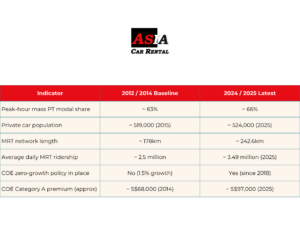 The picture that emerges is nuanced. MRT ridership has grown substantially in absolute terms, and the network is significantly larger. But as a share of total peak-hour trips, the shift away from private vehicles has been modest. Car numbers have been effectively frozen by policy, not by a voluntary shift in preference. And COE prices – the most direct market signal of car ownership demand – have reached record highs, suggesting that Singaporeans who can afford it are still willing to pay very large sums for the right to own a car.
Why the Desire for Car Ownership Persists
To understand why twelve years of investment in public transport have not substantially shifted car ownership desire, it is necessary to look honestly at why Singaporeans want cars in the first place. The answer is not primarily financial irrationality. It is a combination of genuine functional needs, climate realities, cultural values, and the limits of what public transport can realistically provide.
1. The Family Dependency Argument
For many Singaporeans, the car is not a luxury – it is a logistical necessity. Consider a dual-income household with two school-age children and an elderly parent. Mornings involve a school run before the commute to work. Evenings involve picking up children from school and ferrying them to enrichment classes. Weekends mean hospital visits, grocery runs, and family outings. Every one of these trips can be made by public transport in theory. In practice, the combination of timing constraints, weather, luggage, and the sheer number of legs involved makes a car not just more convenient but, for many families, essential.
“If I were living alone, definitely, I could go car-lite or even go completely without a car – that wouldn’t be an issue. But when I have dependants, it’s very difficult.” – A Singaporean car owner, quoted in The Straits Times, May 2026
Singapore’s ageing population amplifies this effect. As more households include elderly members who are less mobile and more dependent on door-to-door transport, the functional case for private car ownership only strengthens. Public transport, however well-designed, cannot easily replicate the point-to-point convenience that matters most when you are loading on wheelchair into a boot or accompanying a confused elderly parent.
2. The Climate Problem
Singapore sits just one degree north of the equator. Average temperatures hover around 27 to 32 degrees Celsius year-round. Humidity is almost always above 70 percent. Sudden, torrential thunderstorms can appear within minutes and drench a pedestrian to the skin before they can find shelter.
This is not a trivial point. Singapore has invested meaningfully in sheltered walkways, covered linkways, between MRT stations and housing blocks, and weather-protected cycling paths. But the network of covered connections is still incomplete. Arriving at a bus stop or station in the morning and emerging at your destination office are frequently wet, uncomfortable experiences during rain. The car provides a private, climate-controlled, weatherproof environment that no amount of public transport infrastructure can fully replicate in a tropical climate.
Transport planners have long acknowledged this. As former Centre for Livable Cities director Dr Limin Hee noted, private cars will remain more attractive until Singapore has ample covered walkways and extensive underground and overhead linkages. Building these at a scale that genuinely covers every first-and-last-mile journey is enormously expensive, time-consuming, and subject to the constraints or land scarcity – the very problem that makes the car-lite strategy necessary in the first place.
3. The First-and-Last-Mile Problem
Singapore’s MRT and bus network is dense and efficient by global standards. But the system is fundamentally designed as a radial network that moves people between residential towns and major employment centres, particularly the central business district. For trips that do not follow this spoke-and-hub pattern – for example, cross-island journeys between suburban residential areas, or trips to industrial estates and business parks that are not well-served by rail – public transport often involves multiple transfers, significant walk-times, and journey durations two to three times longer than the equivalent car trip.
The ‘first-and-last-mile’ problem – the difficulty of getting from home to the nearest transit node, and from the alighting point to the actual destination – is acknowledged throughout Singapore’s transport planning literature as the most persistent barrier to higher public transport adoption. Efforts to address it through bus feeder services, cycling paths, and shared mobility have helped at the margins. But for many Singaporean work patterns and lifestyle demands, the first and last mile is still most comfortably, and often most practically, covered by a private vehicle.
4. The Psychological and Aspirational Dimension
Not every reason for car ownership is purely functional. For a generation of Singaporeans who grew up with owning a car was the clearest visible symbol of having made it, the car carries powerful emotional significance. It is a private space, a status signal, and – in a city where living spaces are compact and shared – perhaps the only enclosed domain a person can truly call their own while in transit.
“When I drive, I’m in my own environment, rain or shine. I can blast my own music, think out loud or even cry.” – A Singaporean car owner, quoted in The Straits Times, May 2026
The cultural dimension of a car ownership in Singapore is real and should not be dismissed. As NUS Cities transport consultant Gopinath Menon – who helped design the original Electronic Road Pricing system – has noted, one in three Singaporean households owns a private car because no other mode provides the freedom, comfort, and convenience of a car. Policy can reshape incentives. It cannot easily reshape deeply held values about personal space, autonomy, and social standing.
5. Peak-Hour Crowding and Reliability Concerns
Singapore’s MRT system is genuinely world-class. McKinsey has ranked Singapore’s overall public transport system as the best in the world by multiple criteria. But world-class does not mean perfect. Recurring service disruptions – despite significant investment in reliability improvement – remain a source of anxiety for commuters whose schedules are tight. And during peak hours, particularly on the North-South and East-West Lines, carriage crowding continues to make the experience uncomfortable for many.
For a Singaporean who has experienced a signal failure that made them late for an important meeting, or who dreads the experience of being packed into a carriage during morning rush hour, the decision to absorb a high COE premium to have the certainty of a personal vehicle is not irrational – it is a rational response to a real, lived experience of system imperfection.
Has the Car-Lite Strategy Hit Its Limit?
The central question deserves a direct answer, even if that answer is complicated.
The Case That It Has
Twelve years of sustained, well-funded investment in public transport alternatives have shifted the peak-hour modal share by three percentage points. If that rate of change were to continue linearly, reaching the government’s target of 75 percent modal share by 2030 would require an implausibly rapid acceleration from the current 66 percent. And this modest shift has been achieved against a backdrop of deliberately frozen car population growth – the modal share gains owe something to policy constraint, not purely to the attractiveness of alternatives.
The persistent high demand for COEs, even at prices above S$90,000, is the most honest market signal available. It reflects the revealed preference of Singaporeans who, given the choice between absorbing a six-figure capital cost and relying on public transport, still choose to pay. Price has not killed demand. The car-lite strategy has, in this sense, run up against the limits of what financial disincentives and infrastructure investment alone can achieve when the underlying functional demand for private mobility is real and deeply felt.
Dr Raymond Ong, Associate Professor at NUS, acknowledged this honestly while stopping short of declaring the strategy a failure. He noted that it would be too simplistic to say the car-lite strategy has hit its limit, but conceded that public transport’s gains have been modest relative to the scale of investment.
The Cast That It Has Not – Yet
The counter-argument is that Singapore’s car-lite strategy is a generational project, not a decade-long one, and that judging it by twelve years of modal share data misunderstands the time horizon involved. Urban mobility culture changes slowly. Oslo’s cycling revolution took thirty years of sustained infrastructure investment to fundamentally shift commuting behavior. Tokyo’s extraordinary public transport dominance reflects generations of transit-oriented urban planning. Singapore is a much younger city, and the cultural shift toward car-free or car-lite behavior is genuinely observable among younger Singaporeans who have grown up with a much denser and more reliable transit network than their parents had.
There are also policy tools that have not yet been fully developed. ERP 2.0 – Singapore’s next-generation satellite-based road pricing system, whose on-board units were rolled out across the vehicle fleet by end-2025 – has the technical capability to support distance-based charging. If implemented, this would transform how Singaporeans pay for road use: from a fixed cost at specific gantries to a variable cost based on every kilometre driven. The economic incentive structure this creates is fundamentally more powerful than anything currently in place. LTA has explicitly stated there are no immediate plans for distance-based charging, but the infrastructure foundation now exists.
Additionally, the Jurong Region Line, Cross Island Line, and future Tengah Line expansions will extend mass transit to residential and employment nodes that have historically been car-dependent. When eight in ten households live within a ten-minute walk of an MRT station – the LTA’s stated goal by the 2030s – the argument that public transport is too inconvenient for first-and-last-mile journeys loses some of its force.
The Honest Assessment: A Plateau, Not a Dead End
The most accurate characterization is that Singapore’s car-lite strategy has reached a natural plateau – not a permanent ceiling, but a point where incremental improvements to public transport will yield diminishing returns in car ownership reduction without complementary demand-side measures.
The easy wins – connecting the unconnected, adding buses to underserved routes, building covered walkways near major interchanges – have largely been made. The residual demand for car ownership in Singapore reflects genuine needs and deeply held preferences that better trains and more cycle paths, by themselves, cannot fully address. Closing the gap further will require either a qualitative leap in what public transport can offer (perhaps through autonomous shared vehicles that solve the first-and-last-mile problem more convincingly) or a more aggressive pricing of private road use that makes the true societal cost of car ownership more apparent to every driver, every time they drive.
What This Means for the Car Rental Industry
The Gap Between Public Transport and Ownership
The persistence of car ownership demand in Singapore, despite world-class public transport, reveals something important: there is a substantial population of Singaporeans who need a car for specific purposes but for whom the economics of full ownership – six-figure COE, high ARF, PARF changes, rising petrol or electricity costs – are increasingly difficult to justify.
This population is growing. As COE premiums have stayed elevated, as the Budget 2026 PARF rebate reductions have increased the effective cost of car ownership, and as ride-hailing prices have risen, the middle ground between ‘full car owner’ and ‘fully car-free’ has become more populated. These are Singaporeans who need a car for the school run, the weekly grocery haul, and the occasional cross-island family trip – but who drive perhaps three or four days a week and could, if the alternative were sufficiently convenient and economical, manage without ownership.
Car Rental as the Car-Lite Middle Ground
This is precisely the segment that car rental is positioned to serve. Long-term car rental offers Singaporeans access to a private vehicle – with all the comfort, convenience, and weather protection they value – without the commitment of a six-figure capital outlay, without the COE price risk, and without the depreciation exposure that has only grown more significant under the new PARF regime.
Short-term rental, similarly, provides a practical solution for Singaporeans who are broadly car-lite in their daily commuting but who periodically need a vehicle for specific occasions: a family day out, an elderly parent’s hospital visit, a trip that a taxi or Grab cannot accommodate practically. Rather than owning a car for the 10% of journeys where public transport is genuinely inconvenient, renting for those specific occasions is an economically sensible and increasingly mainstream approach.
In this sense, car rental is not a competitor to the car-lite strategy – it is a complement to it. A family that rents a car for weekend use and commutes by MRT during the week is, by any reasonable definition, more car-lite than a family that owns a car and drives it everywhere. The rental model enables partial car ownership – the access to a vehicle when needed – without the financial and environmental costs of permanent ownership.
Corporate and Platform Opportunities
The structural trends discussed in this article also create opportunities at the corporate level. Businesses that provide company cars for employees are reassessing whether ownership makes sense given rising costs, changing staff working patterns, and sustainability commitments. Long-term corporate car rental – offering fleet access without capital investment, with maintenance and insurance bundled in – is an increasingly attractive alternative to traditional company car ownership.
Additionally, as Singapore’s autonomous vehicle and shared mobility ecosystem continues to develop – with the April 2026 launch of the Autonomous Intelligent Ride service in Punggol marking a significant milestone – rental companies that invest in understanding and participating in these emerging models will be well-positioned for the next decade of transport transformation.
Frequently Asked Questions
1. What does ‘car-lite’ actually mean in Singapore’s context?
Car-lite does not mean car-free. The term, formally adopted in Singapore’s 2014 Sustainable Singapore Blueprint, refers to a transport culture where private cars are used less and public transport, walking, and cycling are used more. The goal is to reduce Singapore’s overall dependence on private vehicles as a primary mode of transport – particularly for commuting – while acknowledging that cars will continue to play a role in the mobility ecosystem, especially for trips that public transport cannot conveniently serve.
2. Has Singapore’s public transport modal share improved at all?
Yes, but modestly. The share of peak-hour commuters using mass public transport rose from approximately 63 percent in 2012 to 66 percent in 2024 – a gain of three percentage points over twelve years of sustained investment. In absolute terms, MRT ridership has grown more substantially, averaging 3.49 million daily trips in 2025 compared to around 2.5 million a decade earlier, reflecting population growth and network expansion. But as a proportion of total peak-hour trips, the shift away from private vehicles has been limited.
3. Why do Singaporeans still want cars despite excellent transport?
Several structural reasons persist. Singapore’s hot and humid climate makes outdoor commuting uncomfortable, and rain is frequent and unpredictable. The first-and-last-mile connectivity problem – getting from home to the nearest transit node and from the alighting point to the final destination – remains real for many trip patterns.
Families with young children or elderly dependants have genuine functional needs for door-to-door transport. And for many Singaporeans, the car carries significant psychological value as a private, personal space in a city where living areas are compact. These factors do not disappear simply because trains are more frequent and reliable.
4. What is the COE system and does it work as intended?
The Certificate of Entitlement is a license to own a vehicle in Singapore for ten years. It is allocated via a bidding system, with the total number of COEs available each period limited by the Land Transport Authority to control overall vehicle numbers. The system has been effective in capping the absolute zero of Singapore’s vehicle fleet – the total private car population has been roughly stable at around 524,000 since the zero-growth policy took effect in 2018. However, it has not eliminated demand. Consistently high and occasionally record-breaking COE premiums reflect the strength of that demand, and suggest that the current policy primarily succeeds in pricing lower-income Singaporeans out of car ownership, rather than reducing car ownership desire across the broader population.
5. What is distance-based charging and could it change things?
Distance-based charging is a road pricing model under which drivers pay based on how many kilometres they travel, rather than which fixed gantry points they pass through. Singapore’s new ERP 2.0 system, whose satellite-based on-board units were rolled out to all vehicles by end-2025, is technically capable of supporting distance-based charging. LTA has stated there are no immediate plans to implement it, citing the need for careful policy preparation, including the rationalization of road tax and fuel duties. However, if introduced, distance-based charging would fundamentally change the economics of every additional kilometre driven, providing a far more powerful incentive to reduce car use than the current fixed-gantry ERP system.
6. Is long-term car rental a smarter alternative to ownership given the current environment?
For a growing number of Singaporeans, long-term car rental offers a compelling alternative to ownership. It provides access to a private vehicle – with all the convenience, comfort, and weather protection that makes car ownership appealing – without the six-figure upfront COE and ARF costs, without the depreciation and residual value risk amplified by the Budget 2026 PARF changes, and without the ongoing administrative burden of ownership. For households that need a car regularly but could not justify the total cost of ownership in today’s environment, long-term rental increasingly makes financial and practical sense.
7. Where does car rental fit in Singapore’s car-lite vision?
Car rental is a natural complement to the car-lite strategy, not a contradiction of it. A household that rents a car for specific needs – weekend family trips, hospital visits, cross-island errands – while commuting daily by MRT is, by definition, more car-lite than a household that owns a car and uses it for every trip. Car rental makes personal vehicle access available on a flexible, as-needed basis, aligning well with a society that aspires to reduce car ownership but has not yet been fully served by alternatives for every journey. As Singapore’s car-lite strategy continues to evolve, flexible rental models will likely play an increasingly important role in bridging the gap between the public transport ideal and the complex mobility reality of everyday Singaporean life.
Conclusion
Singapore’s car-lite strategy is one of the most ambitious and well-resourced urban mobility transformations in the world. The investments made over the past decade in rail, bus, walking, and cycling infrastructure are real, substantial, and genuinely world-class. The MRT system that serves Singapore today is dramatically more extensive and capable than the one that existed when the car-lite vision was formally launched.
And yet, Singaporeans keep buying cars. COE premiums remain elevated. The private vehicle population has barely moved. Peak-hour public transport modal share has gained just three percentage points in twelve years. The desire for car ownership persists because it meets real needs – for families managing complex daily logistics, for individuals who value personal space and weather-proof comfort, for those whose work patterns take them to places that trains and buses do not conveniently serve.
Has the car-lite strategy hit its limit? Not permanently, and not entirely. But it has reached a plateau where incremental public transport improvements will yield diminishing returns. Further progress will require either qualitatively better mobility solutions – perhaps through autonomous shared vehicles that genuinely solve the first-and-last-mile problem – or more aggressive demand-side pricing through distance-based road charging. Both are on Singapore’s transport planning horizon. Neither is imminent.
In the meantime, the growing middle ground between full car ownership and full car-free living presents a genuine opportunity. Car rental – long-term and short-term – serves exactly this population: Singaporeans who need a vehicle sometimes, who cannot justify the capital cost of ownership in today’s policy environment, and who are looking for a flexible, financially sensible way to access personal mobility without the burden of owning it.
At Asia Car Rental, we understand this reality intimately. Whether you need a car for the school run, a weekend family trip, a business commitment across the island, or simply a break from crowded peak-hour trains, we offer the flexibility to access personal mobility on your terms – without the COE, the PARF, or the depreciation. Contact us today to explore how long-term or short-term rental can fit into your Singapore mobility strategy.